

Your fleet needs better safety coverage now. But does that mean replacing working vehicles just to get factory-fit ADAS?
That is the challenge many fleet managers face. Existing vehicles may have years of useful life left, while new safety requirements and fleet safety goals can’t wait for the next replacement cycle.
A practical approach is to retrofit in-service vehicles while specifying factory-fit ADAS on new purchases. This helps close the current coverage gap while building a consistent safety standard for future vehicles.
Let’s compare retrofit and factory-fit ADAS across cost, coverage, integration, and fleet lifecycle.
Why Fleets Don’t Have to Choose One
New-vehicle safety requirements are also moving forward. In Europe, the General Safety Regulation made a range of safety systems mandatory for all new vehicles from July 2024, with additional requirements being phased in over subsequent years.
That creates an important distinction: factory-fit ADAS becomes part of the long-term vehicle standard, but existing vehicles do not automatically gain those capabilities when regulations change.
A 2025 peer-reviewed study on truck ADAS retrofitting highlighted the same fleet-renewal challenge. The researchers noted that the average age of the EU truck fleet is around 12 years, meaning waiting for natural fleet replacement can delay the wider safety benefits of newer ADAS technologies.
7 Factors to Consider When Choosing Retrofit vs. Factory-Fit ADAS
Before choosing a deployment path, look at these seven factors:
- Speed to deployment. Retrofit can put safety features on vehicles already in service without waiting for a new production cycle.
- Remaining asset life. A truck with several productive years left doesn’t need to be replaced simply to gain newer safety technology.
- Capital outlay. Replacing a working vehicle involves far more capital than adding an appropriate retrofit system.
- Depth of integration. Factory-fit systems can be deeply integrated with vehicle electronics, braking, or steering, while retrofit systems generally focus on warnings and monitoring. Southeast Asian research highlights the need to consider local road and weather conditions when evaluating ADAS performance
- Mixed fleet complexity. Retrofit can help standardize safety capabilities across vehicles from different manufacturers and model years.
- Standardization on long cycles. A fleet purchasing the same vehicle platform year after year can build a consistent factory-fit safety baseline into new acquisitions.
- The coverage gap. Every vehicle that remains without relevant safety technology while an operator waits for its replacement cycle represents time during which the fleet has less coverage.
Retrofit also protects the value already sitting in an existing fleet. Instead of retiring vehicles early, operators can add suitable ADAS capabilities and continue using productive assets.
The technology choice should still account for vehicle compatibility, installation, calibration, driver acceptance, and the specific ADAS functions being deployed.
What Real-World Crash Data Shows
The case for closing the coverage gap isn’t based only on theory.
A 2024 U.S. Department of Transportation study analyzed data from 54,250 trucks across 117 fleets, covering 5.72 billion miles. Compared with trucks without ADAS, trucks equipped with forward collision warning were associated with about a 30% lower crash rate, while trucks with AEB and FCW were associated with about a 40% lower crash rate. Trucks equipped with lane departure warning had a 21% lower crash rate.
A separate 2025 U.S. DOT study of approximately 25,000 Class 8 trucks operated by 62 carriers found that FCW was associated with a 22% decrease in police-reportable crashes per vehicle mile traveled and a 44% reduction in rear-end crash rates. AEB was associated with 12% fewer overall crashes and 41% fewer rear-end crashes.
ASEAN research supports the case for wider ADAS adoption. A 2024 study found that technologies such as AEB and lane-keeping assistance could further reduce road deaths and injuries across Southeast Asia.
These are associations from real-world fleet data, but they show why waiting for every existing truck to naturally age out can leave a long period without relevant safety coverage.
How Much Does ADAS Retrofit Cost?
Aftermarket ADAS CV systems can be a practical way to add safety capabilities to vehicles already operating in a fleet.
The exact ADAS retrofit cost depends on the technology, vehicle compatibility, installation, calibration, connectivity, and whether the system provides warnings, monitoring, or deeper vehicle integration.
A 2025 peer-reviewed study examining truck ADAS retrofits in an Italian case study estimated:
- Forward collision warning retrofit costs of roughly EUR 250-900 per vehicle
- A calculated FCW break-even cost of about EUR 1,228
- The study estimated potential annual societal-cost savings of more than EUR 350 million and more than 250 lives saved in its modeled Italian fleet scenario.
The study also found that many retrofit systems combine multiple functions, meaning the economics should not be judged by the cost of one ADAS feature in isolation.
For fleet managers, the better calculation is therefore not simply
The hardware price is the retrofit cost
It should include installation, calibration, downtime, vehicle compatibility, maintenance, and the operational value of getting coverage onto vehicles that are already working.
When Does Factory-Fit ADAS Make Sense?
OEM factory-fit ADAS follows a different cost curve.
When an OEM builds safety technology into a vehicle during production, it can design the sensors, electronics, wiring, software, and vehicle integration around that platform from the beginning.
That can provide deeper integration and a consistent configuration across vehicles built to the same specification.
Novus also works across the OEM side of ADAS through its Vehicle OEM solutions, which focus on ADAS solutions for vehicle manufacturers.
But factory-fit economics depend on more than fleet size.
A fleet-size factory-fit decision should consider:
- How many vehicles the operator buys each year
- How quickly the fleet is replaced
- Whether the same vehicle platform is purchased repeatedly
- Required integration depth
- Vehicle lifecycle
- Procurement and production timelines
- The cost of leaving existing vehicles without coverage while waiting for replacement
A large fleet with a slow replacement cycle may still need retrofit. A smaller fleet buying a consistent vehicle platform every year may find factory-fit integration more practical.
The decision depends on more than fleet size. Annual replacement rate, vehicle life, platform standardization, and integration requirements all shape the economics.
Safe Pro vs OEM ADAS: Which Vehicles Do They Fit?
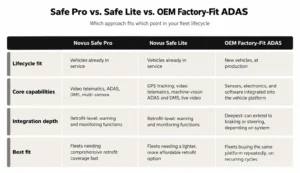
Novus Safe Pro and Safe Lite are designed around the aftermarket side of the equation, helping operators add ADAS and video-based safety capabilities to vehicles already in service – see how each stacks up against OEM factory-fit ADAS below.
How to Use Retrofit and Factory-Fit Together
A dual strategy can look like this:
- Existing fleet, safety deadline close: Deploy an appropriate Safe Pro or Safe Lite configuration without waiting for vehicle replacement.
- New platform, recurring purchases: Specify factory-fit ADAS as part of the vehicle configuration.
- Mixed fleet, old and new vehicles: Retrofit legacy vehicles while using factory-fit ADAS on new purchases.
- Uncertain replacement cycle: Close the immediate coverage gap first, then standardize future purchases around the desired factory configuration.
For a broader look at commercial fleet ADAS deployment, see the Novus commercial fleet ADAS implementation guide.
Choosing the Right Approach for Your Fleet
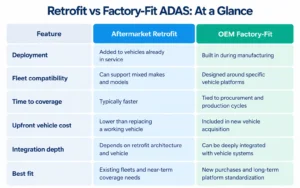
Retrofit vs. factory-fit ADAS is ultimately a sequencing decision driven by speed, asset life, capital, integration depth, replacement cycles, and current coverage.
If you’re mapping this against your own fleet or production line, a Novus solutions engineer can help evaluate the right approach for your vehicle mix.
Need help deciding which approach fits your fleet? Get in touch with the Novus team to discuss your ADAS requirements.